


Does it hurt when you walk up or down stairs, get up from a chair or sit for a long time with your knees bent? The pain may be coming from the joint behind your kneecap. This can be a sign of patellofemoral osteoarthritis, a form of knee osteoarthritis that can make everyday activities difficult. But help is available. With the right treatment and a brace that suits your symptoms, it can become easier to move and stay active in everyday life.
Does this sound familiar?
✓ Pain at the front of the knee or behind the kneecap
✓ Pain when walking up or down stairs
✓ Difficulty or pain when getting up from a chair
✓ Pain when sitting for a long time with your knees bent
✓ Clicking or a grinding feeling in the knee
What happens in the knee?
Behind the kneecap there is a joint where the kneecap glides against the thigh bone every time you bend and straighten your leg. The joint surfaces are covered with cartilage that makes the movement soft and smooth. With osteoarthritis, the cartilage gradually becomes thinner and changes. This can lead to pain, stiffness and sometimes swelling, especially when the knee is bent and carrying your body weight at the same time. Doctors call osteoarthritis behind the kneecap patellofemoral osteoarthritis.
Not everyone with pain behind the kneecap has osteoarthritis. Similar symptoms can have other causes, so it is important to get the right diagnosis. It is also common for osteoarthritis to affect several parts of the knee at the same time, both behind the kneecap and on the inside or outside of the knee. When osteoarthritis has affected the kneecap or several parts of the knee, it has previously been very difficult to find a solution.
Why doesn’t every knee brace suit everyone?
A knee brace can be a good complement to exercise and other treatment for knee osteoarthritis, especially braces developed specifically for osteoarthritis, known as OA braces. An OA brace helps offload the side of the knee affected by osteoarthritis and makes it easier to do activities that would otherwise be painful. However, most traditional unloader OA braces are designed to reduce the load on either the inside or the outside of the knee, known as medial or lateral osteoarthritis, by changing how the load is distributed between the different sides of the knee joint. Traditional knee braces can be a good option if the osteoarthritis is mainly on one side.
But if you have pain behind the kneecap, or if the osteoarthritis affects several parts of the knee, you may need a different type of offloading. This is where a new type of OA brace comes in.
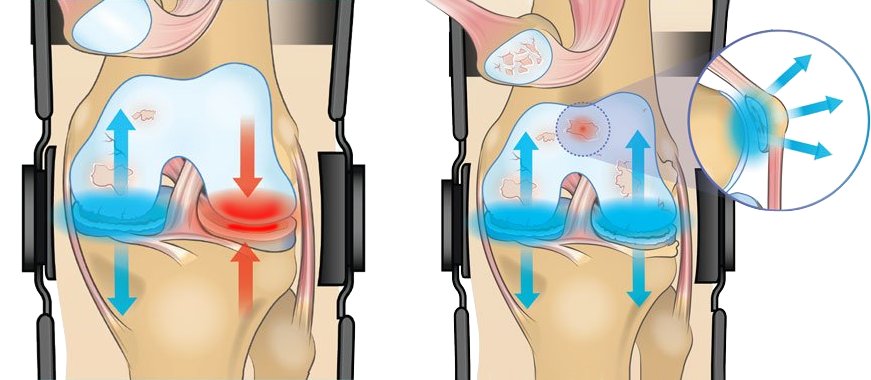
Traditional OA brace
The image shows a traditional OA brace with three-point support. It reduces osteoarthritis-related pain by applying pressure that opens up the affected side of the knee joint. However, the pressure is limited to either the lateral or the medial side of the knee.
Spring Loaded OA brace
Spring Loaded offloads the entire knee joint and therefore has a pain-relieving effect in osteoarthritis behind the kneecap, as well as in osteoarthritis affecting several parts of the knee.
Spring Loaded – a knee brace with an integrated spring mechanism
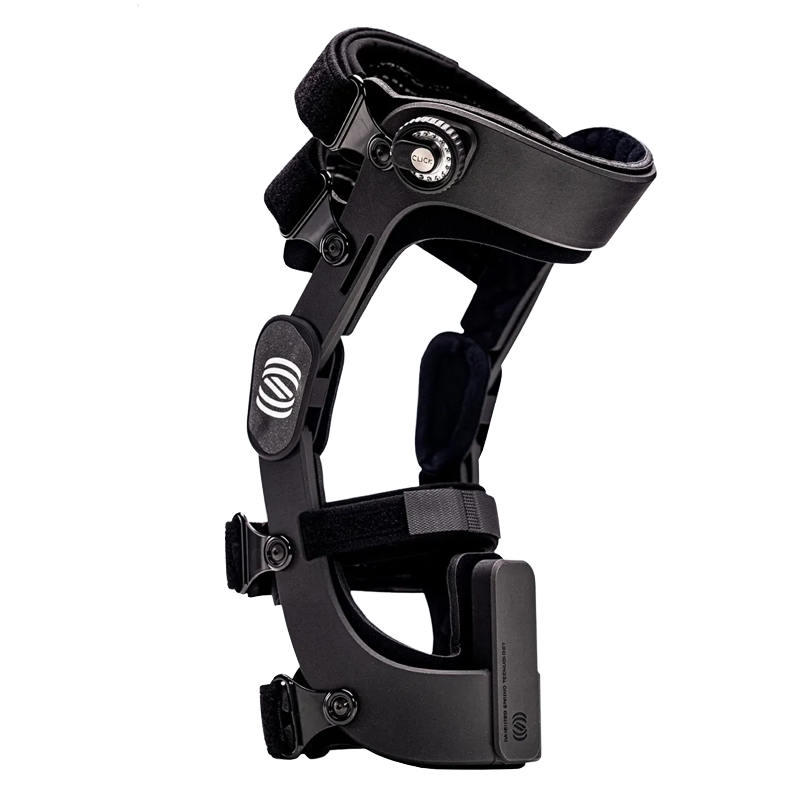
Spring Loaded is an OA brace developed specifically to help people with knee pain, including osteoarthritis behind the kneecap or in several parts of the knee joint. Unlike traditional unloader knee braces, it uses an integrated spring mechanism that helps push the lower leg forward as you straighten your knee. This is how it works:
- When you bend your knee, the spring stores energy.
- When you straighten your knee, the energy is released and the spring helps you with the movement.
In other words, the spring does part of the work that the thigh muscle would otherwise have to do on its own. When the muscle does not have to work as hard, some of the pressure in the knee joint is also reduced, both behind the kneecap and in the rest of the knee. This makes Spring Loaded particularly interesting if you have patellofemoral osteoarthritis or osteoarthritis in several places at once. You can also adjust how soft or firm the spring should be, for example depending on the activity you want to do.
What does the research say?
Spring Loaded’s technology has been examined in several scientific studies, where the brace is called Levitation or Tricompartment Offloader (TCO). The results are promising and show that the technology can reduce the load in several parts of the knee joint.
Less load when you sit down
In a study from 2023, researchers examined how the brace affected the load in the knee when people with osteoarthritis got up from and sat down on a chair.1 When the participants sat down with the brace at a high assistance level, the calculated load behind the kneecap was reduced by about 26 per cent and in the rest of the knee joint by about 23 per cent, compared with when the brace provided no assistance.
Less pain and better function
In another study from 2021, 40 people with different forms of knee osteoarthritis were followed before and after they started using the brace.2 Among other things, the results showed that:
- average pain decreased by 36.6 mm on a scale from 0 to 100 mm
- 39 out of 40 participants experienced improved physical function
- 70 per cent said they had increased their physical activity in everyday life.
These are positive results, but the study had no comparison group, so it is not possible to say for certain how much of the improvement was due to the brace. More research is needed to better understand the long-term effects. Overall, the studies provide interesting scientific support for the technology and its ability to offload several parts of the knee joint at the same time.1–3
Which knee brace is right for you?
It depends on where in the knee you have pain, how active you are and which activities you want to be able to do. If the osteoarthritis is mainly on the inside or outside of the knee, a traditional unloader OA brace may be a good option. If, on the other hand, you have pain behind the kneecap or osteoarthritis in several places, Spring Loaded may be an option worth exploring. There is no knee brace that suits everyone. That is why it is important to get help finding the right solution for your symptoms and needs.
Help is available

Having knee pain does not have to mean giving up the activities you enjoy. There are different ways to treat and relieve the symptoms, and a knee brace can be a valuable complement. An OA brace such as Spring Loaded offloads the knee, and in studies users have reported less pain and better function. This can make it easier to exercise for longer and stay more active – which is also important in osteoarthritis. Talk to your doctor, physiotherapist or orthotist about your symptoms. They can help you assess which type of OA brace suits your knee.
Scientific references
- Bishop EL et al. (2023). Tricompartment offloader knee brace reduces contact forces in adults with multicompartment knee osteoarthritis. Journal of Orthopaedic Research, 41(9), 1925–1933. https://doi.org/10.1002/jor.25556
- Budarick AR et al. (2021). Preliminary Evaluation of a New Orthotic for Patellofemoral and Multicompartment Knee Osteoarthritis. Rehabilitation Research and Practice, 2021:5923721. https://doi.org/10.1155/2021/5923721
- McGibbon CA et al. (2021). Biomechanical Study of a Tricompartmental Unloader Brace for Patellofemoral or Multicompartment Knee Osteoarthritis. Frontiers in Bioengineering and Biotechnology, 8:604860. https://doi.org/10.3389/fbioe.2020.604860